
How much does one credit cost? Why we price AI work in euros
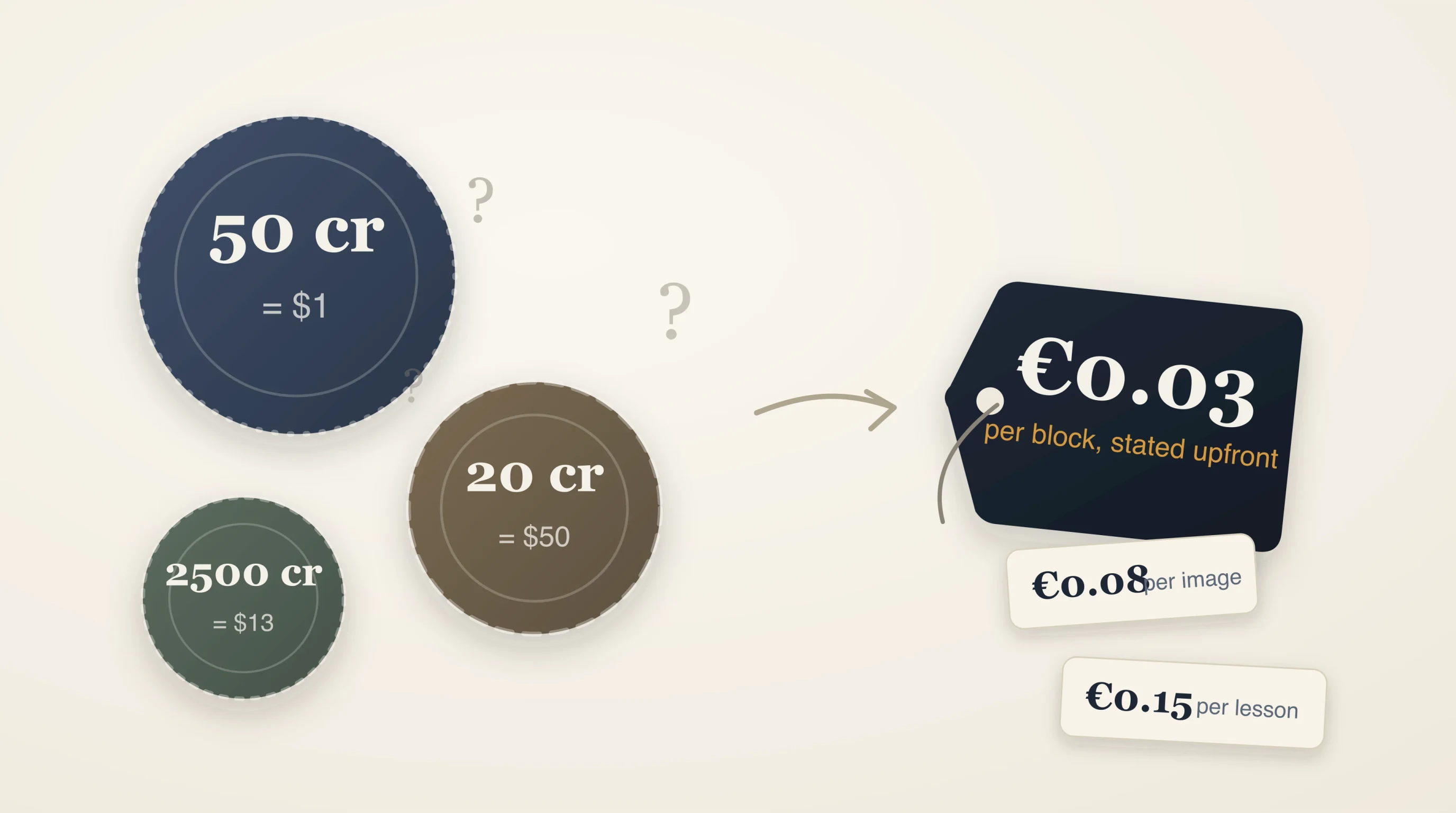
How much does one credit cost?
I recently compared three AI e-learning tools, and got three answers: $1 buys 50 credits. $50 buys 20 credits. $13 buys 2,500 credits.
You can't compare those — and that's the point. A credit isn't a unit of anything. It doesn't measure tokens, or minutes, or images, or effort. It's whatever each vendor decides it is, and each vendor decides differently.
Then comes the second layer. Once you've decoded what a credit costs, you still don't know what anything costs in credits. One course might consume 5 credits or 150, depending on how many lessons it has, whether it generates images, whether there's a video. So the two numbers you'd need to answer the only question that matters — what will this course cost me? — are both unknowns, and they multiply.
That's not an accident of sloppy pricing pages. It's the design.
Why vendors like credits
Let me steelman the credit system properly, because we used one too.
Model prices move. The cost of a state-of-the-art model call has changed dramatically — in both directions — over the past two years. A new model ships, it's better and cheaper; a provider repriced; you switch image generators. If your public price is "€0.08 per image," every one of those moves either eats your margin or forces a visible price change. If your public price is "8 credits," you can quietly re-map credits to costs and never touch the pricing page. Credits are a currency you control, pegged to nothing.
Decoupling feels better. Spending 40 credits doesn't activate the same part of the brain as spending €2.30. Game designers have known this forever — arcade tokens, in-app gems, casino chips. Once money becomes points, people stop doing arithmetic.
Breakage is profit. Credits expire, plans reset monthly, unused balances evaporate. The gap between credits sold and credits redeemed is quietly one of the best margins in software.
The first reason is legitimate engineering economics. The other two are the vendor's gain purchased with the customer's clarity. And all three share one property: they move the uncertainty from the vendor's spreadsheet to the customer's.
What that uncertainty costs the buyer
If you're an individual tinkering on a free plan, credit opacity is a mild annoyance. If you're an L&D manager or a consultant, it's a real problem:
- You can't budget. "How much will our compliance refresh cost to build?" deserves a number, not "it depends on credit consumption."
- You can't compare tools. Fifty credits per dollar versus 2,500 credits per thirteen dollars is not a comparison, it's a riddle.
- You can't invoice confidently. Consultants building courses for clients need to pass costs through. "Approximately some credits" doesn't survive contact with a client's procurement team.
- You learn the real price only after spending it. The first accurate data point about what a course costs arrives when the credits are already gone.
Our own credit system, and what we watched happen
LearnBuilder started with credits like everyone else, and for the textbook reason: our underlying costs do move. We sit on top of language models, image generators, video generators and speech synthesis, from multiple providers, and their prices change more often than anyone would like.
Two things made us tear it out anyway.
First, we watched authors get surprised. Someone would generate a full course — outline, ten lessons, thirty images — and only afterwards discover what it had consumed. Nothing was mispriced; everything was unknowable in advance. The most common pricing question we got wasn't "is this expensive?" but "what is this going to cost me?" — asked before pressing the button, by people who had already paid us money and still couldn't answer it.
Second, we noticed we were maintaining a conversion table whose only function was to stand between our customers and a number we already knew. Internally, every AI action always had a real cost in euros. The credit was just a costume it wore in public.
So we removed the costume.
What pricing in euros actually looks like
Today every AI action in LearnBuilder has a published price in euro cents, and that stated price is exactly what lands on your ledger:
- Creating or regenerating a block: €0.03
- Improving a text: €0.02
- Generating an image: €0.06
- Generating a lesson's text content: €0.15
- A course outline: €0.25
- An interactive slideshow: €0.25
- Video: €0.10 per second of produced footage
- Audio narration: €0.12 per 1,000 characters (roughly a minute of speech)
Three product decisions sit behind that list, and they matter more than the numbers themselves:
The stated price is the charged price. We seeded each price from real ledger averages and rounded up to a friendly value, so the actual provider cost stays at or below what we state. When a model gets cheaper, our margin breathes; when one gets pricier, we absorb it until we update the list. The volatility is our problem now. That's the entire trade.
You see the price before, during and after. The course wizard shows a euro estimate on the create button before you commit — and a "set up course only" path that costs nothing, so you can build the structure first and generate content when you're ready. Every generation shows a receipt when it finishes ("AI cost: €0.03"). And every course has an AI-costs page where the receipts add up, per lesson, so "what did this course cost to build?" is a page you open, not a reconstruction exercise.
Learner-time stays honest too. Interactions that happen while learners use a course — quiz grading, AI dialogue turns, tutor questions — are metered at their actual cost, typically around a cent each, and forecast at publish time so you know what a running course costs before you enroll anyone.
Is your balance still prepaid? Yes — you top up in euros and spend in euros. A prepaid balance isn't the problem with credits. The made-up unit is.
The trade-offs, honestly
Euro pricing isn't free for us. We carry the model-price risk that credits would have exported to you. We occasionally have to update a price on a public list, visibly, instead of silently re-mapping a conversion. And there's a psychological cost to showing small numbers: some vendors would rather you not think about the fact that a generated image costs eight cents, because visible smallness invites the question of what their markup is.
We think that question is fair. I'd rather explain one number than a conversion table.
The only credit system that would work
When I asked on LinkedIn whether anyone had seen a credit system that actually made budgeting easier, the honest answer I could construct is: yes — one where credits are pegged 1:1 to a currency, every action has a published credit price, you see an estimate before you spend and a receipt after.
But look at that system for a second. A unit pegged to money, with visible prices, estimates and receipts — that's just money, wearing a badge that says "credit." Every property that makes it budgetable is a property of currency pricing. The only thing the credit layer adds back is the vendor's option to quietly change the peg later.
So we skipped the badge. A block costs three cents. An image costs eight. Your course's build cost is a number on a page, in a currency your finance team already understands.
That's the whole feature.